Sunday, December 21, 2014

Lifeline - Chapter 1

NOTE: I am very excited to announce that Founders House Publishing has just published Lifeline!!

You can order the book for $19.99 (or ebook for $6.99) from:

 http://www.foundershousepublishing.com/2017/03/lifeline-novel.html

Thanks to all who read it! I appreciated all the helpful feedback.


Saturday, June 21, 2008

I'm Not Dead, I've Moved

Just a note to anyone who might stumble across this site (hah!)-- I have shifted my attention to my newer blog at homesweet-or.blogspot.com, where I am posting at least weekly, and hoping to attract the attentions of a larger audience... please come see me there!

(This is just a placeholder, since to post photos on Green Wizards, I have to have them online already).


Sunday, December 09, 2007

Check out my Other Blog

Forgive me as I go through a huge transition: moving into a new home. You can follow the exploits in "Home Sweet..." on www.homesweet-or.blogspot.com. Thanks!

Sunday, November 18, 2007

The Worms Go In, The Worms Go Out...

One thing I am looking forward to so much that I spend happy spare minutes doodling up plans, picturing the results, promising myself that it’s “coming soon” is…. compost. Yes, I have a hidden lust for recycling garbage. It has been almost a year since I was last able to compost, and I have a jones to see a pile of steaming straw, leaves and coffee grounds in my backyard. Those of you who have not taken a walk on the wildlife side need to picture the immense pleasure of throwing away the wettest, nastiest parts of your trash -- and finding rich, brown soil the next season. It is nothing short of a miracle, well worth the effort of layering dry over wet, and tossing it around a few times over the intervening months. For one thing, I have no idea how the word gets around to so many worms -- I don’t put them there! But within a month, the bottom of the heap is full of happy worms, and the resulting worm shit will create a happy garden. I’ll never forget my little brother moving out near me one year, getting “volunteered” to help turn the compost in the Fall and laughing his head off at my rapturous description (similar to the above) -- and then the next spring having his “revelation” -- yelping and gesturing about all the incredible dirt that magically had appeared in the pile. I enjoyed my “big sister” moment quite a bit.

Those of you who buy your candy bars and bottles of pop, your boxes of computer disks, etc. because they promise a possible $10,000 “free prize” -- you need to look at this really, truly “something for nothing” that is available to so many. Having rented for a year, I know that it’s not available to all, and that saddens me. But having also lived in a group situation, where I have gone to the compost bin and found old bread, meat bones and cat litter, I am not naïve enough to suggest that apartment houses can sustain compost bins. This is a commitment that has to be made by the individual.. oddly, the computer phrase “garbage in, garbage out” applies here, too -- not everything can be composted, at least not in the same bin. I have been reading about old farms and how they recycle “everything but the curl in the pig’s tail“, but unless you are set up for the full recycle process (sounds like about 5 acres) complete with animals who will eat any spare meat scraps, and making soap and candles from tallow, then some stuff does end up in the trash. But any vegetable scraps, coffee grounds (I add the paper cone filter), cut grass, dead leaves -- weeds if you are brave and have at least a journeyman level composting ability -- all of it that would have ended up being hauled away as trash becomes the exact same wonderful rich stuff that you buy for $6.99 a bag under the name “Black Gold -- with worm castings”(that’s wormshit -- but you knew that, right?). Instead of $30 every spring plus the gas to transport it, you have free compost! Alright, some folks would argue that there is a bit of sweat equity involved, but again, why pay $200/month for a gym when you have the chance to work it all off in the backyard? And depending on your pile, it’s not even that much heavy lifting… but I suppose I’m probably preaching to the choir. You wormheads are reading this and nodding eagerly, the others have clicked over to another blog… ah, well.

Since it’s just us recycle freaks here now… I’ll confess that I am looking forward to figuring out how to reuse as much of my purchased stuff as possible. Compost is actually the easy part. All those plastic meat trays are a challenge… I know that the solution is to buy in bulk and select carefully (and - vegans are screaming - don‘t eat meat!), and I will also enjoy trying to figure out which packaging becomes the best recycled art (if nothing else can be done with it, make art?). But really, there is a limit to how many soap bottle maiden dollies I can craft… and I know I’m not alone in noticing the correlation between slowing down and being able to deal sensibly with one’s garbage. With only one foot in the conspiracy-theory camp, I wonder sometimes if racing us around isn’t a really good strategy for making us buy more and more disposable items? I have spent a lot of time this past year trying to make my own lunches, reuse my lunchbags, etc… and whenever I have a day with too many appointments, it all goes astray and I end up eating fast food and tossing the container. But that’s another blog.

Tuesday, November 06, 2007

Passing Seasons, Passing Life


This morning the sun is streaming down on the horse chestnut, and the leaves glow butter yellow and spring green. The fact of the coming winter, or their dead companions below them do not seem to sully the brilliance as they create a sunlight bouquet. When the wind picks up, a snowfall of brown leaves culled from somewhere in the branches begins to shower down on the drifts piled on the lawn. It is early morning, November, and I have the gift of time to ponder these beautiful dying leaves, as I watch through the picture window. Across the lawn, I see Sara walking with her cup of tea, heading for her ceramics studio; starting the day with some creativity. It encourages me; a fellow artist -- she is putting the art first, instead of stacking it behind laundry and shopping, as many women do. Likewise, I’m working on the writing when the morning, and my energy, is young and fresh, before I’ve had the many tiny disappointments that do as much as “free radicals in the bloodstream” to wear on me and sap my strength.

I don’t understand why it takes as much courage to sit still here, to give myself over to recording my thoughts and the best description of the day that I can muster, as it does to face down an angry patient in the psyche unit where I used to work. Why does it take courage to reject the American values of shopping, racing around, going to every event one can cram in or sit glazed-eyed with tv or internet when you can’t? Especially since most of the time we are engaged in these standard practices, we are also simultaneously complaining about them? When I first anticipated giving up my office job and finding a very frugal living situation so that I have time to pursue my creativity (art and writing), I thought it would be pure pleasure. Now I find the pleasure is mixed with an amazing amount of anxiety and guilt -- could it be that in following the standard lifestyle, we avoid having to ask ourselves -- daily -- what our lives are about? Because that is what is coming up, over and over. Why does that horse chestnut hypnotize me with its calm beauty? Why am I so driven to chronicle the neighbor’s sheep over the seasons? Why do I spend hours on one 16-line poem about a lake I love? And what does it say about me as a friend or family member that I would prefer this to some social gathering or chance to chat on the phone? Perhaps these are women’s questions -- why do I prefer creative solitude to relationship? (Though of course I’d love both -- it’s just that they each take time, and often I have to choose). But the question of why am I different from the herd is a universal question, genderless, and asked throughout time.

I watch the shadows drawing in, shortening as the sun works its way up the sky. In November the shadows will be abundant through the day, at least at this latitude. I feel my usual pang of sadness at the lateness of the season; not surprisingly, middle-age has brought the deep connection to harvest, dying and the ending of so much that was vigorously flourishing all summer. Hopefully there are a few seasons left for me to anticipate, yet it still takes courage to sit here and feel the pull as the leaves break, drift and fall to the ground, to decompose into the soil. Often I shake off the melancholy and grab a rake -- anything to be busy, to make active use of the situation. Today I’m resisting; I’m trying to experience the November morning in all its glory and grief, to simply be with the melancholy beauty. (Okay, I am writing about it -- that is activity, and not simply being… but it’s as close as I can get.)

On reflection, I think part of the courage requirement comes from the fact that when I’m still enough to feel the many emotional currents that are not just in my life, but in my surroundings, ugly fears arise. When I chronicle the sheepcote, I also must, to be honest, describe the plowed up field that now has ribbons of white concrete curb, like a map drawn right in the ground -- a map of the 32 new houses that will be crammed into two acres. The stubble of wheat gives way to the stubble of wires sticking from the ground; the pipes and pink-ribboned stakes that dot the mud… and feel like a stake in my heart. Everywhere the cancerous growth of cookie-cutter suburbs spring up, almost overnight. The land stretches out, helpless, waiting to be sliced and diced and transformed into something unrecognizable. Even massive old trees like the horse chestnut have no protection from this impetuous devouring -- “it could happen to anyone, anytime” is the message, just like cancer. And being still, walking the lanes, brings up that unnatural death as well as the seasonal death that is often disguised rebirth. In making my choice to back off from the mainstream and find a more quiet sidestream life, I have also chosen a life that seems to be under assault from all sides -- how long before it’s not even feasible? I’m just about to move away from this quiet, wonderful place to a town much farther out in the country, in the hopes that I can defend my choice financially for at least several more years… but even there I ran across another McMansionville going up on the other end of town; cookie-cutter houses crammed so close you have no need of side window awnings -- nor room for them! -- and my fear of being overwhelmed by this culture’s suicidal rush to corporate dependence. Another community totally reliant on cars to rush the kids to soccer or drive to the Walmart in the next town -- and to start demanding the same cookie-cutter stores that they supposedly moved to the country to get away from? Or are they dong what I’m trying -- looking for a cheap version of what they have in town? But in their case, they want suburbia to come to them -- god forbid! I hate to say this is making me actually hope for a “crash” soon, but it is… somehow this spoilage of our natural beauty has to end, and if there is no other way to stop it, then a crash it has to be… It will affect me as much as anyone, but as someone who loves nature as much as I love family & friends, I will suffer willingly.

And this process feels surprisingly like middle age -- aware that an ending will come; that the life and energy we have now will wane, and yet trying to live in and love the moment -- now -- when it is still here. Not looking back at the abundance that is no more, not looking forward to the inevitable winter, the dark night -- sitting here with the glowing yellow and green leaves, breathing in and out the crisp Fall air; giving thanks for today’s beauty and life.

Thursday, November 01, 2007

I am… a Writer!

I will never forget the day that it finally dawned on me that all the wonderful stories and poems I had been learning in school and filling myself with at home came from actual people -- not dead people, but people who actually made money with their writing! By this time, I was already industriously scribbling in any notepad or pile of paper I could get, doing double homework whenever we were assigned creative writing (in Catholic school, built on the Imitatio Christi, --imitation is the only form of learning -- that wasn’t often) and also, by 4th grade, amusing my friends with short limericks using their names. And many little stories written just for me. But it wasn’t until seventh grade, when I had come back from the blissful year away from the Westfield cliques, and had once again been relegated to underdog, that I by the purest accident, discovered mana from Heaven in the form of a magazine.

Ted’s Smoke Shop was one of those oversized closets that used to pass as stores in small towns -- it literally had one “aisle” that became seriously overcrowded with three customers. It had floor-to-ceiling shelves on three walls; I swear the fourth wall was only big enough for the door. So going in was not exactly an anonymous expedition, given that Ted - I suppose it was he; a shy 7th grader didn’t ask -- occupied the back third of the place himself. About three quarters of the shop held smoking items: cigars, cigarettes, lighters behind glass -- it was, as it claimed, a “smoke shop”. But it was also the only place to find magazines other than the three popular women’s pubs that Woolworth‘s had. It’s probably hard to believe a 12 year old could be so naïve, but I don’t think I ever noticed the “men’s” magazines on the lower shelves… I went in to find puzzle magazines, at least until I found it -- the Holy Grail -- a magazine with an inch-high banner that brazenly proclaimed, “The Writer”.

I was dumbstruck when I saw it; chills ran up my spine and made me dizzy. I recall glancing at Ted as if he might forbid me to pick it up, but he merely watched as I lifted it from the rack. It was, I believe, the June issue -- anyway, it was the one that always had the “Light Poetry Markets” (as I discovered, they covered markets in rotation) and it had a glossy solid spring green -- lurid, some might say -- cover that, sans images, listed in black and white the top articles, saving on color printing in a way no current magazine can. I flipped through the advice articles -- imagine, someone kind enough to tell me how to write! But it was the markets that floored me: page after page of “…poems on nature, children, family - 25 words or less, 2 cents per word” that literally opened a whole new world for me, in that moment. With shaking hands, I paid my dollar and quarter, money I had been saving -- yes, I was a very weird child -- for the pocket Shakespeare plays that Westfield Book Store sold. I have no idea what form of snobbery convinced the Bookstore that magazines were below them, but I never saw a Writer issue there… I had to run the gauntlet of Ted’s every time; ducking in like a… but I’m getting ahead.

Outside the shop - inside it was too crowded to do this - I tucked that magazine into whatever school bag I was carrying (they ranged from brown leather accordian-sided saddlebag with brass corners and a 2 inch wide belt closure to green oilcloth rectangles that tore after a month or so) and walked home in a frenzy of expectation. As fast as I could manage, I got through my recitation of the day at school and raced upstairs. I devoured that magazine, reading every word -- even the ads, even the masthead -- as I goggled at the idea that there were lots and lots of writers all over the country -- and that every month a new magazine of advice and paying markets was released to them… no, to us. For that day I joined, forever, the ranks of Writer. Maybe only in my dreams, but irrevocably. I am embarrassed now to think of the ardor that possessed me in those first delicious months.

Embarrassed, but also a little proud. Who else but a dyed-in-the-wool writer would hide the magazine in the largest textbook I had, to read illicit bits of sage wisdom instead of geography during class? Who else would actually hide the magazine from everyone -- friends, family -- in terror that someone would point out all the reasons I couldn’t be a writer? Who else would lug the heavy family Smith-Corona to the attic bedroom and type three copies of my little doggerel poems onto onionskin (stolen from Mom’s desk) so that I could mail off my first -- it felt like a secret society -- submissions? Only an addle-pated, DNA-selected, born scribbler would have been so affected. The cover literally fell off that first issue, as I read, and re-read, and re-read (anything worth doing is worth overdoing -- has always been my motto)… and, like some obsessive perv, I lurked around Ted’s as the month drew to a close, looking to see if a new issue of the magazine had appeared. The magazines were in the back right corner, the better to shield the men’s glossies, I suppose. But I couldn’t just look through the window, or I would have. I remember the acute embarrassment, the inability to ask about the magazine (again, for fear of being told I had no right to it), and finally, after the third or fourth time, Ted finally understanding what I was looking for and telling me what date it usually showed up -- I snapped it up the day it arrived, and then the scene repeated each month, since I couldn’t bear to think of it sitting there for more than a day without me, and was often forced to return 2-3 days running. It think it amused Ted, I know my emotions were pretty obvious and perhaps touching… but I never did ask.

I can not imagine, even now, being confident enough to have asked for a subscription. I’ll bet there are families in which a 12 year old asking to subscribe to The Writer would have been cause for joy and pride -- but I knew instinctively mine was not one of them. There were no writers in my ancestry, and I had already been given pointed advice by many family members about my over-use of the library… so an easy access to writing life was out. And, oddly, the library didn’t carry that magazine until much later -- or, possibly it was in the adult section of the library, which was strictly off-limits for an child not accompanied by parent. I did get a waiver from the librarians (who I knew very well by then) when I was in either 7th or 8th grade, at least two years early… they knew I wasn’t going for D.H. Lawrence or Henry Miller, though I did find a certain forbidden pleasure in Rabinadrath Tagore, who would have been objectionable to my family simply because he was a poet and foreign. But anyway, I considered it a top honor -- much more than a simple sale -- when I finally got an article published in The Writer twenty years later… we each have our secret Everests.

Friday, October 26, 2007

Efficiencies of Scale

I just got off the phone from a survey about my healthcare insurer/provider, and it left me thinking hard about what we today call “efficiency”. Over and over again, I hear that it saves money and time to gather services into large, “efficient” units, to “standardize procedures and outcomes” and generally impose more rules and details into everyone’s lives. Now, that might have been true at the start, but shall we look at it more closely? To start with the healthcare provider: someone (from somewhere among the multi-levels of “management”) had to decide to give this survey, someone(s) else had to create it, another to test it for accuracy, and then a sub-contractor has to give it to hundreds of patients… to find out how they are doing, because the actual product has now become so far removed from those deciding what to produce that they can’t even see it with a telescope.

Instead of going to your local doctor, whom you knew because he/she lived in your town and had the office in his/her house (no, that is not a myth - I grew up that way and I’m only just going gray), you stand on line in a clinic the size of Macy’s and put your little plastic card in some holder for some clerk to scan and find your record in some computer system that has taken several years to create and takes several fulltime programmers to maintain. Before: 1 doctor, maybe one part-time clerk; Now: a staff of hundreds, a parking lot the size of Rhode Island, more paperwork than would fit in the New York Public Library -- and still there’s not enough staff to actually give you a decent answer.

Or another example: it is more “efficient” to have hog farms the size of the Woodstock Festival (I wonder why that came to mind?), trucking in thousands of pounds of feed every month (week?), generating enough toxic (though mostly organic) waste to fill Lake Mead (no joke: “In 1995 an eight-acre hog-waste lagoon in North Carolina burst, spilling 25 million gallons of manure into the New River. The spill killed about 10 million fish and closed 364,000 acres of coastal wetlands to shellfishing“ -National Resources Defense Council), fouling the air around the farms such that the poor victims - er, neighbors -- have to get air filters, or seal themselves into their houses, or move… (more disturbing facts from the NRDC: “Large hog farms emit hydrogen sulfide, a gas that most often causes flu-like symptoms in humans, but at high concentrations can lead to brain damage. In 1998, the National Institute of Health reported that 19 people died as a result of hydrogen sulfide emissions from manure pits)…. than to have a hundred hogs that require about 140 lbs of soybean meal each for their whole lifespan (my best guess from highly technical online jargon), generate just enough waste to manure the local fields (thus making it a benefit rather than a toxin), do not require antibiotics because they’re not crammed in like NYC subway riders, and need only a moderate size truck (versus a convoy) to take to slaughter… where’s the savings, exactly? Okay, you have to come up with 99 fewer hog farm names, but otherwise…

I think when they talk “efficiencies of scale” they are not at all taking into effect the several added layers of supervision, organization & planning, survey-taking, rule making and printing, network maintaining and just plain getting-lost-in-the-systeming that the modern behemoth system takes these days. How can it possibly be more efficient to spend half of every work day just filling out papers saying what you’ve not had time to do?? (And trust me, in the mental health system, that’s where it’s gotten to). This is barely touching the surface, but since I’m not striving for efficiency, this will have to do for today. By tomorrow I'll figure out why healthcare and hog farms seem linked in my mental train of thought...

Thursday, October 25, 2007

Apology Chains

It seems that as our lives get busier, they begin to resemble those dangerous high-speed traffic jams that increasingly clog our highways. I race through my day, depending on every other person to skillfully race through at exactly the same pace such that we don’t crash into each other. And, of course, there are almost daily “fender benders” -- the chiropractic visit where an emergency client means I’m ½ hour late being seen, meaning I have to apologize for being late at my next meeting, and then they have to apologize for being late getting out… an endless chain of apologies, looping and overlooping through our lives. And just as it is dangerously crazy to drive 70 mph with less than one car length between you and the next speeding car, it seems as foolish to drive our lives faster and faster, counting on some Grace or miracle to get us through each day with no “collisions”. The faster reaction-speed required of living in the fast lane are certainly taxing my energy, focus and emotionally resiliency - how about you?

I have attempted on some days to stay in the “slow lane” (which is itself speeding up) and leave “sufficient braking space” between appointments, and yet those spaces seem to attract (just like cutting-in cars) little tasks that will “just take a moment” and of course nearly or in fact lead to a appointment fender-bender or at least another frantic adrenalin moment, swerving to avoid some mistake or crossed-purpose. And how many times have I acted based on very insufficient information, only to find I’d over-reacted as a gut response to a non-danger (tree shadow rather than obstacle, friend feeling cranky rather than angry at me) simply because I‘m moving too fast to make a more considered response?

I wish I could say I had some answers; I don’t (except the usual safe driving hints, which seem applicable here), but I am intrigued with the pattern. Isn’t it interesting that we have this parallel between racing around physically and racing around virtually, organizationally, intellectually and even emotionally? Perhaps Someone’s trying to tell us something? Is there a “safe speed” for being human, and have our cultural super highways exceeded that? I am tending (obviously) toward “yes” as the answer to both questions, and hence I will be moving soon to a much small town, planning to have much more open schedule and much less real driving; hoping, in fact that there is indeed still some “byways of humanity” where I don’t have to live with one foot on the gas and one on the brake.

Tuesday, October 16, 2007

Fine Print

I’m becoming more and more worried at the various “agreements” we are forced to sign or click on in the course of our basic lives. Can it really be an agreement if 1) we don’t have any viable other choice, and 2)we can’t take the time to read and understand every word? I think that would be called coercion and fraud even a generation ago (and don‘t we have some memorable “Snidley Whiplash“ cartoons depicting just that?). I have been told that there is now a clause in the contract I agreed to for this blog that can cancel my access to it if I complain or make them look bad. That may actually seem like a logical request at the level of policy (I suppose if I had to deal constantly with tens of thousands of “partners”, I’d get a little unilateral in my policy statements, purely from nerves), but someone pointed out the tragic consequences for free speech and community. I agree. There is a difference between sliming someone or thing, and complaining. We seem to have lost the ability to determine that boundary.


I also found a clause within this blog’s terms that allows them to use any image uploaded here -- for free, for any use anywhere to promote themselves, for as long as the image is up on the web (and for a certain “reasonable” time after that). I don’t know if that clause was in the old agreement, but it has stopped me from sharing my photography with you (you can check it out on cathymcguire.com). I am strongly reminded of the 1980’s when the idea of e-books was just being conceived of -- and the publishing houses wasted no time in slipping clauses, granting them total rights, into all of their book contracts! I was in SFWA at the time, and there were workshops at the conferences for us to learn whether/how we could either eliminate or negotiate those clauses out of the contracts… the publishers were basically using their muscle to keep us minor authors from having a chance to say no before we even realized what we were saying no to… isn’t that what’s happening now? And without “unions” such as SWFA, there was no ability to push back… is it time for a blogger’s union? Some group that will threaten to pull all the bloggers (big and small, famous and unknown) off a site if the conditions get too autocratic? I know unions have gotten a bad name recently (and some of that is, of course, the opposition smearing them, but some is their own greed or foolishness), but as someone whose grandfathers were in the carpenter’s union during the Depression, I have heard enough stories to understand the need for some group that can represent the “work currency” that the corporations basically bank and then turn around and charge the workers for creating. I’m not a Marxist, but I believe strongly in balance. It’s the only healthy way to live, and unbalance is actually as bad for the corporations as for the workers. Because what happens (we all know) is that those who have the ability to leave a corporation (including the smartest, most capable) will leave if there is a stifling, autocratic regime, and eventually the corporation collapses under the weight of toadyism and mediocrity. Simplified, but true. So in fact the dynamic balance between benefits for workers and for owners is good for both sides. So I choose to believe that when the workers (or bloggers in this case) push back, they are in the end benefiting all.

Saturday, October 13, 2007

New Beginning

As usual, there is no clear line of “beginning” - like the edges of objects that we imagine but are nothing more than a shift of light, or tone, in a colored image, -- like the “moment of dawn” that is instead a gradual awareness of a slow shift in light -- the start of something emerges incrementally from the overall landscape of our lives. For me, this move and shift of job tasks has actually coalesced slowly, over time, as one thing after another fell apart in my life; as I found “the usual” to be like a death sentence and didn’t know why. Now, after an incredibly painful two years, I find some clarity and some deep response inside to my decision to settle in the country, work from home and live as frugally as possible. It’s amazing how many strands go into weaving this pathway: the environment -- political, economic and physical; my own aging and limitations; relationships that have outlived their vibrancy and withered before my eyes; and some inner push that -- I see now -- has been urging me all my life. There are moments when I wonder if this is all ephemeral, a delusion, and moments when I wonder how I could have missed this clear calling for so long. Naturally, this leads me to feeling fairly schizoid; how can one person have two such clear and mutually exclusive points of view?? But perhaps that’s a cultural bias: we are trained to believe that “I” am one/single and as such would have one point of view, subject to changes, yes, but only one real way of seeing things. Anyone who struggles with really split POVs are referred to therapy. Yet now it’s starting to seem more natural that there is always a push-pull, a light/dark rhythm to the way we see and live life. Dynamic balance seems to demand that we move back and forth, ever correcting our excesses. How else to do that but by holding two points of view and comparing/contrasting? For some, I think this comes more as feelings and sensations, for me it’s definitely ideas and concepts. In any case, the balance has tipped and I am moving forward with another chapter in my life; one that I hope will allow me more time to observe, to think and to write.

Sunday, October 07, 2007

NVC and GWB

Last night, I dreamt I tried NonViolent Communication on George W. Bush. You know, that form of communication where you don’t point fingers, where you assume that your perspective is no better or worse than the other person’s -- that insane belief that any person can be “connected to” as “an authentic human being” if we just stick to identifying our feelings and needs.

I was sitting with him over a light dinner of veal medallions and pretzels, and I am not sure what our previous conversation had been, but I just started in:

“ George, when you tell me that Iraq has nuclear weapons and that they were involved in 9/11, and then I find out it’s a lie, I feel hurt, angry and frightened. What I need is security and a sense that my leader is telling the truth or trying hard to. What I want from you is to get out of Iraq.”

He leaned back and grinned wolfishly; apparently he’d done Cheney-training in recent days - the wolf was quite impressive. And someone had taught him non-violent ju-jitsu.

“When you elect me president and tell me you want me to lead, and then reject me in the polls, I feel hurt, angry and proud of myself for standing tall. What I need is your confidence in me as a leader. What I want from you is admiration, trust and silence.”

I blinked, and tried again. “George, when you continue to swear to me that you are acting responsibly and truthfully, after so many reports and facts have been uncovered that prove otherwise, I feel scared. When you continue to ignore mine and others’ requests that you stop the spying on Americans and the illegal, unethical torture of other nationals, I feel angry, scared and frustrated. What I need is to feel respected and to have a mutually honest relationship. What I want from you is to honor your promises, for a start, and also to listen to the overwhelming worldwide chorus of protests against your fear-mongering to cover the illegal, unethical actions that you have decreed.”

He laughed and reached over to pat my hand. The “I’m just a feller” face came over his features, and he smiled roguishly.

“Honey, when I hear you parroting the words of gutless liberals and Democrats with an agenda, I feel frustrated but also amused. What I need is to lead, because God wants me to. What I want is you to get off my back.”

At that moment he grinned, popped a pretzel in his mouth -- and choked on it. While he was gasping, I threw another couple in his mouth and left. Better the pretzel in the president than being pretzeled by a president. Using NVC against denial is like trying to sop up the ocean with a Kleenex.

But seriously, this tongue-in-cheek dialogue shows all my objections to this new craze of non-violent communications. The flaw in it is that it only works on rational people who have integrity.. and the vast majority of our communications problems stem from those who don’t. If you try to use NVC on those who are in denial, who are manipulating (consciously or unconsciously) or who are irrational, you end up “speaking your truth”, having to leave it at that and often being retaliated against! So what’s the point?

There is a large chunk of wishful thinking in the whole NVC movement and I am sorry to say that I have only seen it used by those who were lying to themselves or others -- those who refused to take accountability for their own actions but instead were trying to “excuse” their actions under the guise of “my perception is as valid as yours”. Anyone want to say that the Hutu warriors who are systematically raping women and girls in the Congo have a “valid” perception?? Yes, that’s extreme, but whenever anyone says NVC can be used on “anyone”, that and good ol’ Dubya are the two examples I think of… There are times when people need to be confronted -- bluntly -- on their bad behavior, and it needs to be called bad, and it needs to stop. What NVC emphasizes is our lack of control of others’ behavior -- granted, that is true, but as in any society, we do have control over our own behavior and response, and sometimes it’s just denial to keep talking gently to monsters… or even flakes.

Wednesday, October 03, 2007

Solitude and False Community

Like many old concepts, the idea of community is being dusted off and revamped for the new millennium. The word is in everyone’s mouth, and yet it seems everyone has a different idea of what it means. Having just been burned by several years in false community, I have a few of my own ideas.

Community comes from the idea that we are all interdependent; that none of us is really living a life completely self-sustained. It is supposed to recognize our common needs and to honor our individuality while creating a group connection. That is far easier to write about than to live. Jungian therapist Helen Luke cautioned against “the false peace that engenders violence in the unconscious”. I have seen this much too often lately: an attempt to “keep the peace” by covering over conflict, by not saying what one is truly perceiving, as if that might make the perception disappear. Of course it doesn’t, and like a sore tooth, its poison seeps into the blood. Soon there is a noticeable tension between the two people (or groups), and little details get tinged with “this is more of your crap” resentment. The urge to forgive gets swallowed up by the urge to “even the score” or “right the balance“ (depending on how honest you are being with yourself). There is a slim possibility that you can truly become conscious of your resentment and let it go completely (as the New Agers assure us is the “right way“, ignoring any accountability of the other person), but it’s much more likely that the relationship becomes strained and eventually sours, and often by the end there is a confusion as to what exactly ended it. I would say “dishonesty did”. False community is no more healing or supporting than empty calories are nourishing. The form is not the substance. Better to be alone than to be surrounded by false friends.

And as helpful as it is that one person own their own shadow, it is still a two-way relationship -- eventually it becomes obvious the other person (or group) is in denial, is unable/unwilling to see their own falsity, and then there is no more honesty in the relationship. Unless the conscious person accepts the burden of understanding and “holding” the unconscious person(s) (thus creating an unequal relationship), there will be continued conflict, defensiveness, distrust, resentment, until it becomes unbearable. And falsely, blithely “forgiving” (which I see a lot in well-meaning people) is just more of the falsity: you can’t forgive a hurt until you experience and acknowledge exactly how you’ve been hurt. And that’s too painful for many people; they try to skip right over to the forgiveness, but it “doesn’t take” -- the resentment is still there with the hurt, and now it’s even harder to go back and discuss that problem. The proof of whether there is honesty and accountability in a relationship (whether in a two-person relationship or a community) is in how open, honest and trusting the actions are. No amount of verbage will cover the actions, the instinctive defenses that we all put up when we start to distrust. “By their fruits ye shall know them.” But what is very obvious from the outside may take quite a while to recognize from the inside.

Conversely, solitude is also a very popular topic; the need for solitude to renew and recharge, the value of being alone in nature, etc. Yet for all the discussion, I believe that it’s a very small part of the society that actually spends “quality time” alone. Many associates and friends tell me how much they want to, but “can’t find the time”. Yet they spend hours watching tv or shopping. I find it puzzling, when it’s easy to turn off the tv and take a walk or even sit in a room alone (if you’re a parent of young kids, that’s a bigger challenge, to be sure). I sometimes wonder if those who have a reluctance or fear of solitude, of getting away alone, have that because they are already living so “solitarily” in their groups, in their false communities. They already feel isolated by this “stranger culture” where we see more strangers each day than people we know, and perhaps this causes the subconscious sense that no more solitude is wanted or needed. It is a paradox that in some ways we can only be honestly in community or relationship if we can stand alone, if we understand solitude. And most of us may only be able to stand solitude if we believe that somewhere there is a community that embraces us.

Tuesday, September 25, 2007

Moles

On my morning walk, I noticed the neighbor’s new lawn, painstakingly scraped of crab grass, tilled and planted about a month ago, now has a stubble of pure emerald lawn, as neat and suburban as you could hope for -- and this morning, there are five ugly molehills, like blackheads on smooth skin.

There were no molehills previously, so I can only assume they loved the softer, tilled dirt, and are having fun in their new playground. For me, it was a perfect symbol of the individuation process -- after a loss, after a shock, the ground is churned up, but we try to smooth our outer veneer, try to “start again” with a nicer persona, maybe with a new group… and in the unconscious, the moles are making tunnels, and overnight some ugly, ancient memory or emotion has surfaced, all the more obvious in the polished outer veneer. The unconscious cares not for lovely lawn; perfect surfaces are irrelevant. The rich compost thrown up by the digging is the essential element, and no dismay on the ego’s part will dissuade the digger. Stamping down on the mounds just pushes it up elsewhere.

Some people do go to extreme lengths -- flooding, poisoning or dynamiting one’s unconscious via substances leaves poisons in the soil, even if it succeeds for a while in stopping the mounds. Trapping (dealing with individual issues) works more efficiently, but it may be that what is needed is simply to accept that we have moles. Or rather, we have the kind of soil that moles love. And is that so bad? Does that not say that our unconscious is fertile soil? Perhaps the solution is to plant a flower garden, but then, I hear moles love flower roots… so… how to live with moles?

On this, my 52nd birthday, after a very hellish year that saw most of my creative outlets destroyed or cut off, I am learning to live with my moles. I feel a bit like a mole coming up for air… hopefully not as blind, but certainly tunneling my way towards something unseen, unknown. Today, in a wonderful affirmation and synchronicity, I will be taking a step toward a new future, tunneling however blindly, toward a new garden. Re-starting my blog is a part of this… the rest remains to be seen.

Sunday, September 23, 2007

Fall Equinox - Balance

Today, the Fall Equinox, is the day the Earth balances day and night. It is hard, in this culture of artificial light (think of that symbolism!) to be as aware as our ancestors were of this momentary pause, before the dark and the cold sweep in for half a year. Even living in a rural neighborhood, I find myself caught up in new projects, new groups -- the whole “back to school” mentality that contrasts deeply with the Harvest/ pulling-in energy of this season. Of course, in this “rural” neighborhood, apples and pears litter the road and verges, a nuisance rather than a harvest. What seems clear is that our culture has come so far out of balance that we don’t even know where the pivot point is. We attempt balance, but are too far away from center, and we wonder why it doesn’t work. And most people don’t even see why that’s a problem -- our technology allows us to ignore the seasons, the cycles and the environment. Even if we give lip service to them, or mentally acknowledge we are part of the ecology, we have lost the connection that would bring it home on a daily basis. Fall is when the pumpkin lattes are featured; and -- more and more -- when the first Christmas decorations are offered for sale. Merchants shift their products with the seasons, but placing a plastic/gypsum scarecrow on your porch does not alter the psyche. And that is what our environment -- and our psyches -- need desperately right now: a shift, an alteration that puts us back in balance.


But part of that shift is an acknowledgement of death, and that our culture is phobic about. Endings, partings, loss -- we cover it over, make it “go away” refuse to see the many deaths that create the products in our lives, the many deaths that happen all around us daily -- too busy, we say, with our own lives. Until, inevitably, the loss hits us. Even then, we are advised to stay busy, keep going -- rarely do we attempt the descent to the Underworld that is represented by the upcoming season. Those who do find little support or understanding in their neighbors and friends. We call it Seasonal Affective Disorder -- perhaps the problem is that we are resisting our own pull to hibernate, dream, renew? The “depression” could be the gap between how busy the culture wants us to be and our own bodies/psyches asking us to pull in, seed-like, until the next blooming time. Of course, thoughts of suicide are danger signs no matter when they come. But I do wonder if we were given the time to go inward, without feeling like failures, would the process feel as painful and “depressing” as it does now? And would we find hidden treasures in our own depths?


And therein lies the hidden blessing of the season -- if we can accept and reclaim our shadow sides, our darkness, we will find a ground of being that renews, restores and brings us back to the blooming time. We could learn that our lives are in fact a larger version of the same cycle, and therefore aging is akin to this Autumn/Winter but that there is another Spring beyond our perception.

Tuesday, August 08, 2006

Open Letter from a US Marine mom

I am "yielding the podium" today to a neighbor and friend who has a very compelling, very touching open letter that she recently shared with us. I feel that everyone needs to see this letter... thank you Inger, for letting me share this with the world:


Letter to our government, members of Congress and Senators, and to all those in power to make decisions over our strategy in Iraq ( and also in Afghanistan); to all those who form public opinion in our country, and to all American parents:

Please do not sacrifice our soldiers, our sons and daughters, to save your pride! In the Middle East many bullies are fighting to establish their bases of power (directly or by proxy for other super powers). They fight, kill and destroy to inflict maximal damage on their competitors- over the heads of ordinary civilians trying to cope with daily struggle for survival. Our soldiers, all soldiers are used as tools and sacrifices for this power struggle. It is not a fight between “Good” and the “axis of Evil”. It is a staking out of claims by the most powerful to push their agenda on others. One player is not better or more virtuous than another, no matter what their religious leaders say.

Our sons and daughters, including my 22- year old Marine son, are being sacrificed to this slaughter. The governments of the United States and Israel seem to think that if you keep throwing more force, more destruction, and more blood at the battle, it will be won. This did not work during Vietnam. On the contrary- increased violence increased the determination of the Vietnamese to fight harder, more ruthlessly and finally chase the foreign armies into the sea (or helicopters from the roof of the embassy). There are countless examples of wars fought, where the occupying armies ultimately lost to the natural local populations. We know that even small forces can oust a powerful enemy (during our revolutionary war).

This brings me to a second item. During the revolutionary war, our soldiers maintained their civil rights as free citizens to return to their families when they were in need or danger, to go home when the battles became senseless, so they could save their own lives and those of their comrades in arms. There were also many real honest debates about the goals of the struggle, the real motives for the sacrifices made by everyone. Great generals have sounded retreat when it would cost too many lives to keep fighting. There is no dishonor in a sound retreat, a sound strategy for regrouping.

Yet, for some reason our current soldiers have no civil rights anymore. They have lost their rights to free speech and their pursuit of life, freedom and the pursuit of happiness. They get paid minimum wage, often live on outdated, dry MRE meals and 3-4 hours of sleep for weeks on end and they have to suffer frequent verbal and physical abuse by their superiors. They go out on extremely dangerous, often futile missions. They are willing to die for their country yet they have no rights of freedom of _expression. As soon as a soldier or his/her family speak out against the War (any war), refuse to fight against their conscience or want to stay with their family in need, he/she is kicked out, locked up or worse and their families are called unpatriotic or “un- American. Which freedoms exactly are we fighting for!?

I lost my husband (Green Beret Special Forces), the father of my Marine son, to the war in Vietnam, the years of desperation still playing in his mind and soul. He committed suicide years later, still not being able to throw off the terrible things he had experienced. He hated the government for sending him there on such outrageous pretexts, often even denying he was there at all. Their mission: “to keep fighting so the others had not lost their lives in vain”- sound familiar!? The battle in Vietnam was long lost. Hearts and minds had not been won- on the contrary. Our harshness and increasingly alarming amount of cruelty and environmental killing had destroyed what little goodwill still existed for us. Are we going to repeat that kind of thing? Do I now have to lose the next generation to the same pig-headedness of the men in Washington DC?! Do our sons and daughters really have to be sacrificed for a lost cause again?! He is my child, bright, idealistic, well- educated and compassionate. He was going to be such an asset to this country- if we can just keep him alive and sane.

Please, members of Congress and Senate, have pity on your own citizens. Aren’t you parents too? Would you send your child into this kind of hellhole with no hope of “victory”? Please let us stop this madness, pull out now, regroup and rethink. Let us stop sending more missiles to Israel so they can kill innocent Lebanese farmers, women and children. Let us stop fuelling violence- which only begets more violence as the Good Book says. Please let us refrain from further escalation.

I am a freedom loving, law abiding tax payer in this country. My tax money is given to a government that sends it overseas to buy missiles to destroy other civilizations, and I feel responsible. It should be my right to withhold my support for such actions. I do not begrudge paying taxes, if it is for the upkeep of this country’s people and infra structure or even to support other needy countries or peoples. I just feel so powerless and so angry when my hard earned money is used to destroy and kill. I beseech you, please bring our troops home now, stop supporting foreign violence of any kind, and restore sanity, health and freedom to this nation!

No-one wants another world war, or even a Middle East all-out war. Stop all fighting now! Let us pick up the remnants of civilization and evolve. American soldiers are so often used to enforce dictators’ rule over rebellious populations. Military men and women are used as tools to protect commercial interests. There is so much injustice performed by our troops, in the name of patriotism. In this American society does not stand alone. We should be able to stop this insanity and bloodshed. Humanity is not meant to fall back into savagery each time someone cries foul. We are not meant to quote “Holy books” of any kind to devolve into animals. Human Beings are meant to solve the challenges of violence and learn to cope with life in a peaceful and creative manner, with compassion. That is the true battle for hearts and minds of the people.

This is a plea from a US Marine parent, together with many other caring and patriotic mothers and fathers. Bring our Troops Home Now!

Monday, August 07, 2006

Hope... or Hate?

Whew! I really haven’t spent a lot of time on the web; I had not realized what kind of essays are being posted with the implication that they are reasoned responses to the world situation. There was a very frightening blog/essay on the Signs of the Times website, one that made me think of witch hunts, heretic burnings and mob lynchings…

It seems to be an attempt to distance the author (and “us good guys”) from a group of people that he wants to de-humanize. “What if the evil we see around us in the world is not born from human nature?“ Henry See writes. “once you have studied… a psychopath's methods and means of manipulation, once you have understood the individual psychopath and have traced its [emphasis mine] predation as the most successful ones move into positions of power in the law, politics, business, the police and the military…” Granted, these are not nice people -- psychopaths -- but to call them non-humans, and to use the pronoun “it” in referring to a psychopath, put us on the very same path as the psychopath has travelled to get to his/her disconnected, uncaring perspective that others are “things” to be manipulated and/or exterminated. If we call those who act in a way that suggests they have no conscience “non-humans”, as the author did, and specifically state that “we humans” are not and would never be capable of the actions of these “things”, as the author did, we are falling into one of the oldest traps of human psychology, that of projecting all of our evil onto another.

I am not in any way defending the actions or the perceptions of psychopaths or sociopaths (I have met several in my work as therapist; they are not pleasant to be around), but I am appalled that someone who calls himself human would so callously demonize another human just in order to state that he and “us good guys” are free from the kind of evil capacity that “psychopaths” are capable of. And, as is obvious in the essay, he has widely branded many, many people as “psychopaths” with no clinical proof. No, despite his "hope", we are not so easily able to say we would never, ever, do evil to another person -- none of us can guarantee that our minds will always be sane or clear, or that a huge grief or rage would never, ever seize us and cause us to do outrageous things. Yes, there are people who we have learned will do these things repeatedly, but they are of the same human species as we are, and no one has yet found a clear, indisputable cause for their actions. There is a case to be made that there is some biologic elements, but it is a huge leap from there to “non-human”! There is also much evidence that deviant behavior is learned, that psychopaths were not born with their behavior. There is evidence that damage to the frontal lobes of the brain can bring about such behavior -- which means any of us could end up acting as they do, after a certain kind of injury.

The fact that Henry See’s essay is entitled “Hope” makes it even scarier… because his hope seems to come from the possibility of “eradicating” these people, so that “humans” can live happily ever after… this is scary stuff… does anyone hear echoes of Nazi Germany’s “final solution?” Who gets to have the life/death decision in this process of first “isolation of such individuals” and then…?

I understand how frustrated and helpless many people feel right now, in the face of all this violence and runaway greed, but the last thing we need is to herd a group of people -- any group of people -- into some ghetto or to brand them as “other”. Until we learned we are all connected, on a very deep level, this kind of greed and violence will continue.

I hate to publicize his work, but in fairness since I criticized it, here is the link:
http://signs-of-the-times.org/signs/editorials/signs20060807_Hope.php You can tell me if I'm overreacting...

Monday, July 24, 2006

Labyrinths, Mazes and Life’s Path


I am a walker of labyrinths; each month I go to a nearby cathedral and -- to the sound of soft music and with the flicker of candles -- I slowly pace the winding pattern inlaid in the wood floor. I came to this about eight years ago, when a friend mentioned a new way to bring in the New Year, with meditation rather than fireworks and drinking. Once I had walked, I realized this was a wonderful process for me, since I can not sit in meditation.

For those unacquainted with labyrinths, the earliest simple one is pre-historic; the earliest complex (12-fold) labyrinth is in the floor of Chartres cathedral near Paris. Click here to read about that.

Unlike a maze, a labyrinth has only one path, no dead ends… and yet you can not really plot your course because it winds so cleverly that even though it looks symmetrical, you are not just walking switchbacks. As you follow the path, you are suddenly very close to the center, and just as suddenly, you have veered away and are walking near the edge. Sometimes the path reverses quickly, and sometimes there is a long unswerving section… because of the complexity, you can’t really see very far ahead, and if you focus on the long distance, you can lose track of where you are and end up going the opposite direction (by stepping onto the wrong section)… very much like Life, as many people have pointed out.

I am not a fatalist, but I do believe that I have a life path that is unique to me, and that there is something in me that knows my path. As I look back, I see so many choices that I had made intuitively, that seemed “off course”, were actually leading me closer to becoming my unique self. Thus, walking the Labyrinth reminds me that my conscious mind can not see very far forward. My job is to walk the path I see in front of me, and to trust in the wisdom of the Universe. Often, this is hard for me. The monthly meditation shows me how I can be close to the center of an issue, then suddenly feel like I’m back closer to the beginning, or visa versa -- I can be far from center, then without realizing, I‘m almost there. That is part of the process. It also reminds me again and again that this is not a straight path, that spiraling around a core self, a core issue, is much closer to Life’s process than the highways and other straight lines we build. It also is a metaphor for the process of moving away from the world to go deep into my core self, and then, once the center is reached, the process continues with a return to the outside.

Another reason for walking is a ritual of peace… many walkers believe that sending good energy into the world helps mitigate the negativity that abounds. The New Year’s walk especially is an attempt to begin the new cycle with positive, loving, peaceful energy. I know I can feel it when I walk monthly; the others are focused and mindful, and that helps me to focus and bring my attention and will into alignment with a wish for peace. Along with whatever other issue I bring to the meditation, I ask for peace.

It has been scientifically postulated that we humans understand visual symbols on a deeper level than words, because that is the earliest part of our brains. I think that walking a labyrinth reaches a deep part of the walker’s mind with an image of the process that words alone can’t convey. If you have not ever walked a labyrinth, or if it has been a while, click on these links to find a labyrinth walk near you.


http://www.labyrinthsociety.org/
http://www.gracecathedral.org/labyrinth/

Tuesday, July 18, 2006

Making Peace


It’s hard for me to avoid a kind of horrified voyeur attitude toward the Middle East hostilities… wondering when/if someone is gonna go “over the top” and cause the next World War. There’s a kind of helpless fascination, almost as if I’m trying to make it real in my heart, because the photos are ugly and sad, yet it’s still very hard to picture what the citizens of each nation are experiencing as they try to scrape together a “normal” day while fearing a missile strike might “accidently” hit them… we in the US have been so blessed that explosions and attacks are rare… even reading the blogs makes it only a bit more real.

But I read a blog yesterday that has a better attitude than mine - appreciaher response was to do whatever she could to create more “peace energy” in the world. And being a doll artist, that’s where she’s starting. She’s issuing a Peace Doll Challenge to anyone who wants to create a symbol of peace -- check it out at http://www.sacreddollsandbears.com/. I’m gonna do it, as soon as I can! I’ve uploaded an image of a shrine that I’d made a while back, along the same lines, so that’s a start… I'll keep you apprised of what else I do.

Tuesday, July 11, 2006

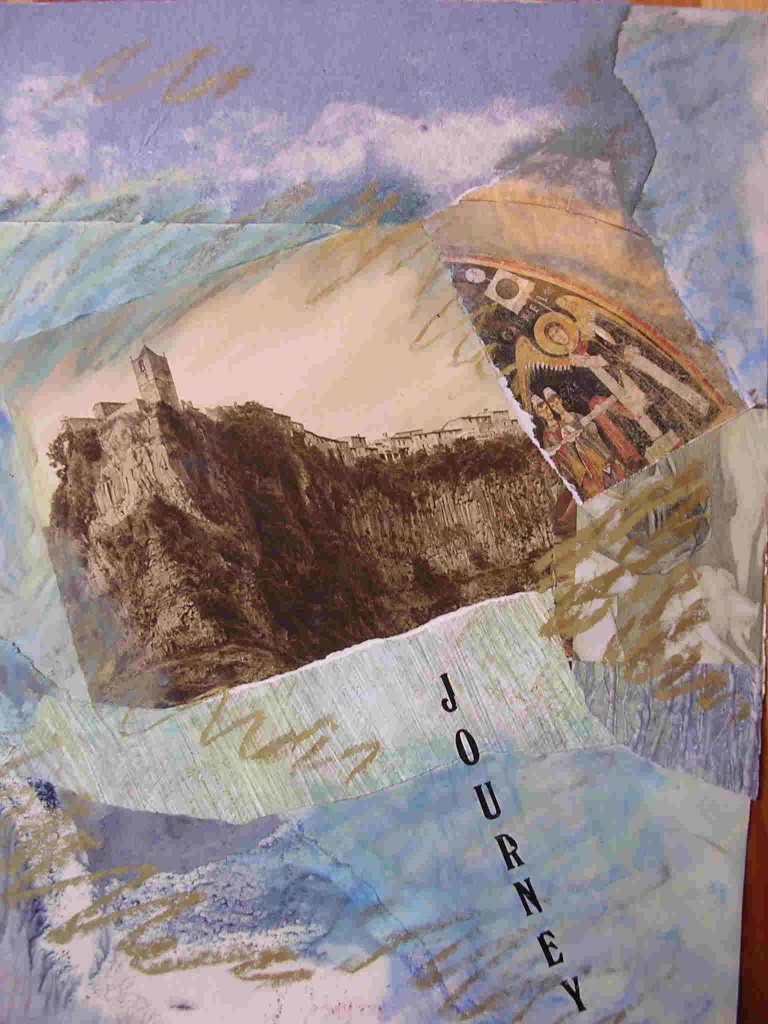
Collage - Second class art?


The New York Times posted an art review last week, called, “Endgame Art? It's Borrow, Sample and Multiply in an Exhibition at Bard College”. Part of the critique caught my eye, because it seemed to lump all “found art” into one category, that of somehow avoiding artmaking. The critic wrote, “To call yourself an artist at all is by definition to announce a faith, however unacknowledged, in some form of originality, first for yourself, second, perhaps, for the rest of us.” http://www.nytimes.com

He went on to write, “Fear of form above all means fear of compression— of an artistic focus that condenses experiences, ideas and feelings into something whole, committed and visually comprehensible. With a few exceptions, forms of collage and assemblage dominate this show: the putting together (or simply putting side by side) of existing images and objects prevails...” and, though he used erudite jargon, he seemed to be implying that this was an inauthentic way of making art.

I have a different take on it: collage and assemblage is a way of acknowledging that things exist before we find them and that our changing them has an effect on the surroundings. Rather than the artist presuming that a blank canvas is in fact “nothing”, found art-making recognizes that we make art with materials. It is not the artist magically calling something into existence from nothing; even those who draw and paint use materials (though some groups work mightily to ignore that and others emphasize it), we co-create with the materials in whatever form we find them. Collage and assemblage merely make this more obvious to the audience, but as an artist, I’m aware of it in whatever medium I use.

Relationship with the world is much in our awareness these days, as we finally see what ignoring the world and its realities has done. When I do collage and assemblage, I begin by experiencing a relationship with a certain item (today it was a wonderfully zig-zagged twig); I know that I am meant to do something with that item. Rather than fear of form, I am recognizing form in something, and entering into a co-creating relationship with it. Then slowly, I bring that item into relationship with other items, allowing their form to show me the possibilities in re-forming and re-aligning… I see it as a metaphor for our age. It may be past the time when ego can be allowed to say, “I create” as if there were nothing used to get started or inspired. It is more realistic, more respectful and more grounded to say, “I co-create”, using what form there is and moving it into new dynamic interaction. Most of us will agree this world has been degraded by too many people demanding to change their surroundings without due attention and care to how those changes affect other living beings -- indeed, they often pretend there is no effect at all! Art has been a metaphor through the ages, and work with collage and assemblage (especially found objects) is, to me, a metaphor of a new relationship with the world around me, and as such it deserves more than second class status.

Sunday, July 02, 2006

Inspiration, Enthusiasm, Joy


Last night, we went to see a local community theater production, a musical with lots of tap-dancing… the actors put everything they had into it, and their enthusiasm was catching, even from the back row where we sat. I was alternately amazed and inspired by their footwork and their unseen-but-obvious talent for sliding out of one costume into the next. It was a delightful evening. Live theater is so different from movies -- there is a relationship that develops between the actors and the audience that somehow beckons the ones who are seated to express our own talents, a kind of subtle “now it’s your turn -- go out and be creative!”

Last night, I wondered what gets a group of local people, all of whom have day jobs, involved in the kind of hard work needed to put on a live theater (or any other kind) of show? There are probably a few in the group who believe it is a stepping stone to greater stardom, or at least full-time work in the field, but they can’t all believe that they are on their way to Broadway… so I assume some are just delighting in the production itself. I did plays in high school, but not since; it’s hard work. I admire those who make the effort in order to bring fun and beauty to the rest of us.

This morning, I’m musing about enthusiasm -- about putting one’s heart in one’s work. Originally, it meant “filled with the energy/spirit of the gods,” (Greek en & theos “god”) it now means an emotional surge of energy toward some goal or idea, often overcoming rational reservations. We have a love/hate relationship with that attitude in America… you can see it in the many movies, plays and stories about the brash innocent who “wins big“, after being hampered by the experienced, cynical professional who may or may not be also “evil”. We want to believe it so, yet fear that it isn’t so. (Incidentally, rarely is the innocent portrayed as an older person; we see enthusiasm as reserved for the young, though in practice, I haven’t found that to be true). What I find when I talk to friends and colleagues is that few of us want to admit to being either character; we usually temper our enthusiasm with a few sentences of “of course, I know there are downsides to it…”, but we also find a lot of fault with the cynic, who seems poisonous. So we all waffle back and forth, a bit worried to be classified at either pole. Enthusiasm is suspect but enticing… an appropriate response, perhaps, to being filled with divine energy. After all, who knows where it might lead?

In my own work, I have experienced times when Time disappears, when the art-making or writing so catches me that I literally lose awareness of my surrounding, until something calls me back. It’s wonderful, and a little scary. It’s unbalanced, in the literal sense of throwing over all other priorities except the current one. It has a driven quality, and it’s hard to say exactly who/what is doing the driving. And when I return to a more typical state of mind, I wonder at the force that sent me off into unexplored areas of creativity. What, exactly, triggered it? What fueled it? When I’m in the moment, I can’t really examine it, but afterward, I look for clues about myself. The “me” that most of the time thinks it’s in charge is shocked to find that it was momentarily unseated. Yet the experience is filled with such joy that I can’t wait to do it again!

Since I have been striving for balance in my life, and since I have experienced that “flipflop” (technically enantiodromia) when too much enthusiasm falls into cynicism, I have been looking for that point of enough but not too much… I’d love to hear if anyone has thoughts on it.

Friday, June 30, 2006

Hoping a Picture is worth a Thousand Words...


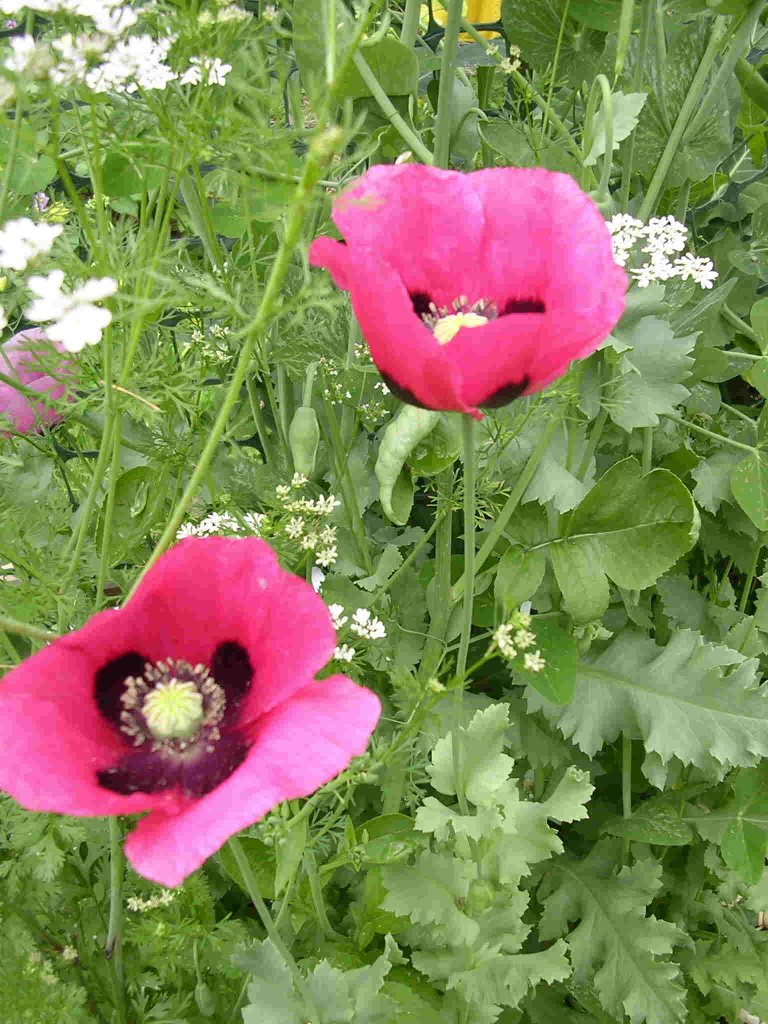
Not liking to just babble, and not having had time to write another short essay for this blog, I instead offer a couple of my recent floral photos for your enjoyment: A neighbor's iris and lily (she has a lovely garden!) and poppies that seem to have volunteered in the veggie bed.

Wednesday, June 28, 2006

Iraq Villanelle

This is a villanelle (a very tight poetry format) that I used to create commentary on the war... despite the strictures of rhyme and meter, I was pleased at how it flowed.

Iraq Villanelle
I think that Bush and Cheney understand,
despite their parochial, privileged lives,
the total candor that true peace demands.

They didn’t find the weapons, as was planned;
now rumors are that underlings connived,
but don’t doubt that Bush and Cheney understand.

Our mop-up army (daily ambushed) and
Iraqi townsfolk need -- to stay alive --
the total candor that true peace demands.

Afghan’s still in shambles, and the Holy land’s
aflame with harsh, pre-emptive drives
that I think Bush and Cheney understand.

Yet partial fact, Code Yellows carefully planned
are what they give us; does this seem contrived --
this “total candor” they know we demand?

Are we too numb? Or don’t we understand:
of all the noble reasons, none survived
the total candor that true peace demands.
Oh, I think Bush and Cheney understand!

Tuesday, June 27, 2006

Summertime and the Living is Easy...

Mid-morning, as the air and ground began to heat up, giving a hint of the 100 plus degree day it was going to be, I sat on the patio and watched a flock of pine siskins swoop and plunge through the dappled leaves. They were so small and swift that at first I thought they were hummingbirds, but my binoculars confirmed the little twitterers were more fluffy and plump. Impossible to count, but there seemed to be from thirty to fifty of them, swirling like leaves in a storm, uttering little cricket pips. Ironically, it was very restful to watch all their frenetic activity; there was a just-so-ness about it that settled me. Knowing I wouldn’t get much done in the day’s heat, I stayed and watched their antics, grateful that they had convened in my grove. For a moment, I was a “being”, not a “doing”.

And somehow that reminded me of the opening scenes of “An Inconvenient Truth”… I know I’ve written about it before, but I’ve noticed that since I’ve seen it, I look at these grace-filled moments in a different light, with the sense that I could lose them entirely. And even if not me, then the next generation, or the next… my thoughts meandered to the trip we’d just taken through eastern Oregon, through the vast rolling Palouse hills that take such enormous effort to raise the wheat we depend on so carelessly. Because it was about 100 degrees that day, my husband and I commented on how easy it seemed for this all to become total desert, with just a couple degrees more heat. We, who are so used to driving to a nearby store for all our sustenance have no real notion of how much work it takes… We were returning from attending a Renaissance Faire in Richland Washington, where again I had been reminded (by things like hand-spun yarn and hand-forged bracelets) of how much more labor is involved in everything we eat, wear and use. Granted, it’s not done by hand anymore (mostly) but still, mass production takes a lot of work in its own way… and we just pluck things off the shelf like they were magic.


So, what if all this began to unravel? It wouldn’t take too many months of extra heat and a sudden unavailability of water to mess up the crops. We’ve already had extreme weather, and the destroyed crops have cause grumping about the high prices… but what if they were just unavailable? None of us are used to empty grocery shelves, as some countries are. But just a couple degrees change could make our lives much more difficult. How easily could we adjust to small, mealy apples or bug-holed string beans, if that was all we had? We toss all that food now, as being un-sellable… I write this not to be a Cassandra, but just to get folks to be more aware of the ease of our lives (which we -- or at least I! -- sometimes forget in grumbling about minor annoyances) and to ask if it isn’t worth a bit more work in order to keep it. Anyone who has not yet alerted your Congress rep. or Senator that global warming is a big issue for you; it’s time to speak up. By the time we really notice it, it will be too late.

Monday, June 26, 2006

Equality, Liberty, Validity

Too often lately, I’ve heard people talk about everyone’s opinions being “equally valid”, by which they seem to mean that by right of being a human, each person is intrinsically equal to each other.... thus their perceptions have equal weight. However, this seems to confuse process with product. As equal members of the human race, we have equal rights to perceive and to express our perceptions; but those perceptions (products) do not have equal sagacity, clarity, and validity. Some perceptions lead us down a dead end; some lead us to greater awareness and growth. Those are not equal!

This assertion of equal validity keeps coming up whenever science and politics collide, for example the global warming issue. It is all too common through the ages that governments and authorities try to suppress discoveries that cause them trouble (look at Gallileo!). Authority has a weakness for one-sided arguments. But I am concerned about the number of people who seem to get no material benefit from ignoring facts, who are being swayed by this erroneous idea of giving “equal weight” to both sides, as if there will always be an equal preponderance of evidence. That’s one of the things I liked best about the debate club in high school -- it was necessary to back up your point of view with evidence, and the best evidence won.

Over and over, I hear that we must give both sides equal rights. Equal right to speak is a benefit to us all, yet once the hackneyed phrases have turned out to have no factual backing, it’s time to put them aside. Defenders of this confusion will point out that in history, too often people were wrong about the value of an idea; that something ultimately turned out to be the opposite of what they thought. They use this to say we must not make judgments, but simply support each opinion equally... until when? We can’t suspend judgment until after our lifetimes; it’s impossible, and judgments after that fact are irrelevant to our lives anyway.

No, despite the possibility that we may be wrong in our judgment, we must make one, as best we can, in the circumstances. To abrogate that is to allow our unconscious to do the job, for -- as our behavior shows -- we make unconscious judgments in all cases where we won’t consciously judge, acting out our preferences. “Not to decide is to decide” , as the old saying goes. And the corollary to that is to admit when we have made a wrong decision (are you listening, Mr. President?) and change our perceptions as new facts become available. To live as if everything were equally true is to live as if nothing is true.

Sunday, June 25, 2006

None So Blind?

This evening I indulged in one of my favorite “sunset celebrations”: just sitting on the patio looking at the thick grove of cedars and maples that separate me from my neighbors. I never noticed it any other place I lived, but here the setting sun hits a spot where it illuminates the underside of the leaves. Shafts of light angle up and turn the usually shadowed sides of alder leaves and pine needles golden; they glow like something out of Lothlorien. It’s magical; there’s no other word for it. Tonight it felt a bit different, because I had just come back from seeing “An Inconvenient Truth”, the very powerful documentary on global warming. And so tonight I could picture this treasured copse of trees browning, struggling for life as the climate gradually became too hostile. I thought of my other treasured spots in Nature. I’m not a hiker, with rare exceptions, so I tend to hang out at lakes or in groves not far from roads, but even there I can find the kind of deep quiet and peace that heals me when I get “fried” in the city. And all of those spots, even the ones that are “protected” by being designated National Park or Forest, are in danger, as the effects of global warming make crazy changes in the climate.

If you haven’t seen the movie, I urge you to do so. You might say, as I did, “I already know those facts”, and yet the information is presented in a form that sears it in your mind. Between the charts of precise measurement and the before/after photographs, you will be sobered. But it’s not an unhopeful movie; almost-President Gore did not run all over the globe bringing this message because he felt there was no hope. He lists many things that can be done to reverse the trend and avoid the worst effects, if not all of them. As he mentioned, it’s not really a choice between economy and ecology… if we lose our planet or even much of our planet, to the catastrophes of an unbalanced climate, we end up losing both! I don’t expect much of an administration that talks about selective nuking, but I can’t believe that the average American is so blind and arrogant as to believe it’s “someone else’s problem”… even if it doesn’t happen in our lifetime, it is not morally defensible to leave it to our children, or grandchildren (or grand nieces and nephews, in my case)… it seems that recently, every time I see a toddler or infant, I wonder what kind of world they will be living in… it frightens me. Until I saw the film, I was like many and felt I couldn’t do much. But I have renewed energy after seeing the possibilities… check it out. I’m putting a link on my site to make it easier for you.

Sadly, even those who have the info staring them in the face are sometimes blind. As I waited for the movie to start, one of the two ushers cleaning said she’d heard it was a powerful movie. The other usher said, “Which one?” “This one -- the one on global warming.” “I didn’t even know we had a movie on global warming”… at that point I couldn’t resist; I said, “You’d better stay and watch it -- it’s your generation that will have to deal with it.” But I’m hoping that my generation -- that I -- can find a few more things to do before we pass this crisis on.